Top Marketo Alternatives & Competitors based on 2228 Reviews
Reviews collected from
capterra.com
trustpilot.com
trustradius.com
sitejabber.com
gartner.com
reviews.io
.
| Brand | Pricing |
|---|---|
|
|
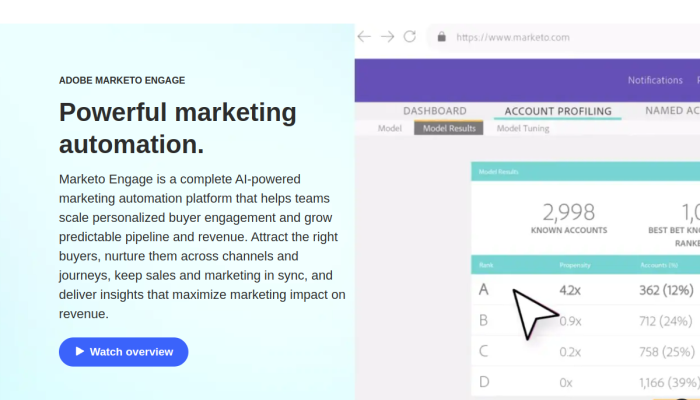
Marketo offers a range of pricing plans tailored for different business needs, with packages that include features for marketing automation, lead management, and campaign management. Pricing is often customized based on the size and requirements of the organization, encouraging interested customers to contact sales for tailored quotes. |
|
☆ ☆ |
ActiveCampaign provides tiered pricing starting from a basic plan to more advanced options. The plans are determined by the number of contacts, with additional tiers offering advanced automation, CRM features, and reporting. Specific pricing details require users to create an account to view personalized quotes based on their needs. |
|
☆ |
Close has a straightforward pricing model with three tiers: Starter, Professional, and Business. Each tier provides a unique set of features focused on CRM, sales automation, and calling. Prices vary based on the selected tier and are charged on a monthly or yearly basis with discounts for annual payments. |
|
☆ ☆ ☆ |
HubSpot offers a freemium model for its basic tools, with paid plans in several tiers for Marketing, Sales, and Service hubs. Pricing grows based on the size of the team and the scope of features required. Discounts are available for annual subscriptions, and specific quotes are provided based on the selected features. |
|
☆ ☆ |
Keap provides three main pricing tiers: Grow, Pro, and Max, each designed for different business sizes and needs. Pricing includes features like CRM, marketing automation, and billing, with specific costs depending on the number of contacts and users. Discounted annual pricing is also available. |
|
☆ |
Pipedrive has four pricing tiers—Essential, Advanced, Professional, and Enterprise—each offering increasingly sophisticated features for sales management. Pricing is based on a per-user, per-month model, with discounts available for annual subscriptions. |
|
|
Salesforce Essentials offers two pricing options primarily for small businesses. The pricing is on a per-user, per-month basis and includes CRM tools tailored for small teams. Users are encouraged to contact Salesforce for larger scale deployments and additional features. |
|
☆ ☆ ☆ |
Zendesk’s sales solutions pricing is tiered and varies based on selected features. Plans are available for teams of all sizes, with three main pricing levels: Team, Professional, and Enterprise, along with add-ons for enhanced functionality. The pricing model is subscription-based and annual plans offer discounts. |
|
☆ ☆ ☆ |
Zoho offers a wide array of pricing plans for its services, including a free tier with limited features. Paid plans vary based on the number of users and features, with options for customization. Annual subscriptions yield significant savings compared to monthly payments. |
Why should you be looking for a Marketo alternative?
Users may seek alternatives to Marketo for various reasons, including specific feature requirements, user-friendliness, budget constraints, and support options. As businesses evolve, the need for more tailored solutions becomes evident, prompting a search for platforms that better align with their goals. Top alternatives include ActiveCampaign, Close.io, HubSpot, Keap, Pipedrive, Salesforce, Zendesk, and Zoho. This discussion will explore each option’s unique features, pricing, and target users, helping you make an informed decision based on your organization’s needs.
Quick Overview of Top Marketo Competitors
-
ActiveCampaign – Best Marketo Alternative for Email Marketing Automation
Offers advanced email marketing features, marketing automation, and CRM capabilities. Its user-friendly interface allows small to medium-sized businesses to create targeted campaigns easily. Unique strengths include powerful segmentation and automation workflows that drive personalized customer experiences. -
Close.io – Best Marketo Competitor for Sales-Focused Teams
Designed specifically for sales teams, Close.io combines CRM functionalities with calling and email tools in one platform. Its built-in communication features improve team efficiency and help drive conversions. The focus on sales productivity sets it apart from Marketo’s broader marketing scope. -
HubSpot – Most Comprehensive Marketo Alternative for Inbound Marketing
Offers a robust CRM accompanied by powerful marketing tools, including content management, social media management, and analytics. HubSpot’s extensive free features and seamless integration across its software suite support businesses looking for all-in-one solutions, often at a lower cost than Marketo. -
Keap – Best Marketo Alternative for Small Businesses
Keap specializes in CRM and marketing automation for small businesses, offering intuitive tools for managing customer relationships and automating workflows. Key strengths include easy-to-use features like appointment scheduling and payment processing, catering to entrepreneurs looking for simplicity. -
Pipedrive – Most User-Friendly Marketo Competitor for Sales CRM
Pipedrive focuses on pipeline management, allowing users to visualize their sales process easily. The automation features help streamline repetitive tasks, enhancing team productivity. Its sales-centric features distinguish it from Marketo’s primarily marketing-focused approach. -
Salesforce – Top Marketo Alternative for Enterprise Solutions
Known for its extensive customization and integration capabilities, Salesforce is a leading CRM platform for larger organizations. It offers extensive analytics, reporting, and support for complex business needs, alongside strong marketing capabilities that compete directly with Marketo. -
Zendesk – Best Marketo Competitor for Customer Support Integration
Primarily a customer service platform, Zendesk excels in integrating customer support with CRM functions. The seamless transition between customer service and sales helps businesses provide excellent customer experiences, which is an aspect Marketo does not emphasize as strongly. -
Zoho – Most Affordable Marketo Alternative with Comprehensive Tools
Zoho offers a suite of business applications, including CRM, email marketing, and project management tools, at an affordable price point. Its flexibility, scalability, and rich feature set make it a strong competitor against Marketo, especially for startups and small to medium businesses looking for budget-friendly solutions.
Marketo Alternatives: Feature by Feature Comparison
| Feature | ActiveCampaign | Close.io | HubSpot | Keap | Pipedrive | Salesforce | Zendesk | Zoho | Comparison with Marketo |
|---|---|---|---|---|---|---|---|---|---|
| Email Automation | Advanced automation with user-friendly workflows. | Basic email sequences, focused on personal outreach. | Comprehensive workflows with deep customization. | Automation for customer follow-up and task management. | Intuitive email automation and customizable pipelines. | Highly customizable automation for marketing/sales. | Basic email triggers, more support-focused. | Basic automation, focused on CRM functionality. | ActiveCampaign and HubSpot offer easier automation setup than Marketo. |
| CRM Integration | Built-in CRM for seamless marketing/sales alignment. | Integrated CRM for sales-focused teams. | Fully integrated CRM with marketing automation. | Centralized customer information for follow-ups. | Strong pipeline management as a CRM. | Extensive CRM capabilities with advanced analytics. | CRM functionalities but more customer service-oriented. | Integrated CRM with sales automation and reporting. | Salesforce offers superior CRM capabilities compared to Marketo. |
| Lead Scoring | Dynamic lead scoring based on engagement metrics. | Basic lead scoring focused on sales activities. | Comprehensive lead scoring based on multiple criteria. | Limited lead scoring primarily for sales follow-up. | Flexible scoring options based on sales stages. | Advanced scoring and segmentation features. | Limited lead scoring focused on support interactions. | Basic lead scoring prioritizing leads for sales. | Salesforce’s lead scoring is more advanced than Marketo. |
| Reporting & Analytics | Detailed reports with actionable insights. | Focused on sales metrics and call tracking. | Comprehensive reporting across marketing and sales. | Basic reporting mainly for sales performance. | Visual reports tracking sales efficiency. | Extensive reporting capabilities with customizable dashboards. | Basic reporting for customer interactions. | Customizable reports across sales and marketing. | HubSpot’s reporting capabilities are more robust than Marketo. |
| User Experience | Intuitive and accessible for all user levels. | Streamlined and focused for sales users. | User-friendly interface for marketers and sales teams. | Simple and user-friendly for small businesses. | Clean and focused design for sales pipelines. | Feature-rich but steeper learning curve for new users. | Simple interface primarily for support staff. | Generally user-friendly but can be complex. | ActiveCampaign offers a better user experience than Marketo. |
| Support | 24/7 customer support via multiple channels. | Live chat and email support for users. | Extensive resources with community support. | Limited support options based on plan. | Email and chat support primarily for sales issues. | Comprehensive support with numerous resources. | 24/7 support focused on customer service queries. | Standard support options with varying response times. | Salesforce’s support is more extensive than Marketo. |
| Pricing | Competitive pricing with a free tier available. | Transparent pricing tailored for startups. | Free tier available, escalates with features. | Mid-range pricing with focus on small businesses. | Cost-effective for small to medium-sized businesses. | Premium pricing tiered based on capabilities. | Free tier with an emphasis on customer service tools. | Affordable pricing for basic CRM functionalities. | ActiveCampaign provides better pricing options compared to Marketo. |
| Customer Segmentation | Advanced segmentation based on behaviors and demographics. | Basic segmentation for targeting leads. | Extensive options for segmenting audience lists. | Limited segmentation focused on customers. | Visual pipeline for segmented sales activities. | Powerful segmentation capabilities for marketing. | Basic segmentation for support inquiries. | Segmentation options based on customer data. | HubSpot shows superior segmentation compared to Marketo. |
| Marketing Automation | Robust marketing automation capabilities tailored for small businesses. | Simple automations focusing on sales outreach. | Industry-leading marketing automation features. | Marketing automation primarily for follow-up actions. | Basic marketing automation targeting sales stages. | Advanced automation integrated with sales processes. | Limited marketing automation, focusing on support initiatives. | Basic automation with CRM integration but limited features. | HubSpot provides a more comprehensive suite of marketing automation tools than Marketo. |
Unique or Superior Aspects:
- ActiveCampaign: Offers user-friendly automation with affordable pricing and a free tier, making it accessible for small businesses.
- Close.io: Designed for sales teams with a strong focus on personal outreach, ideal for startups.
- HubSpot: Offers extensive features with a robust free tier and powerful marketing automation capabilities, surpassing Marketo in segmentation and reporting.
- Keap: Primarily aimed at small businesses with limited needs, but offers straightforward automations for customer follow-up.
- Pipedrive: Excellent for visual sales pipeline management, with an intuitive interface tailored for sales teams.
- Salesforce: Extensive CRM capabilities with advanced analytics, offering a more complex but feature-rich solution compared to Marketo.
- Zendesk: Focused on customer service with 24/7 support; however, it lacks the comprehensive marketing features of Marketo.
- Zoho: Budget-friendly CRM and essential sales automation features but can lack depth compared to Marketo’s capabilities.
Integration Capabilities for each Marketo competitor
| Alternative | Supported Integrations | Compatibility Notes |
|---|---|---|
| ActiveCampaign | – Shopify – WordPress – WooCommerce – Salesforce – Zapier – Typeform |
Strong integration with ecommerce and CRM tools. Ideal for marketing automation. |
| Close.io | – Zapier – Intercom – Slack – QuickBooks – Pipedrive |
Focused on sales force automation with major tools, but fewer native CRM integrations compared to others. |
| HubSpot | – Shopify – WooCommerce – Salesforce – Mailchimp – Zapier |
Extensive integration options, strong support for CRM tools, marketing, and sales alignment. |
| Keap | – PayPal – QuickBooks – WooCommerce – Zapier – Gmail |
Targets small to medium-sized businesses; seamless with ecommerce and finance tools. Limited CRM options. |
| Pipedrive | – Zapier – Mailchimp – Trello – Slack – Google Workspace |
Integrates well with project management and email tools; good CRM compatibility. |
| Salesforce | – Slack – Mailchimp – HubSpot – Google Workspace – QuickBooks |
Extensive CRM capabilities; high number of integrations with various tools. Premium option within CRM space. |
| Zendesk | – Salesforce – Slack – Mailchimp – Jira – QuickBooks |
Strong focus on customer service tools; integrates well with CRM systems for support functionalities. |
| Zoho | – Mailchimp – Google Workspace – QuickBooks – Shopify – Slack |
Offers a comprehensive suite of tools; strong CRM integration capabilities, suitable for businesses of all sizes. |
| Marketo | – Salesforce – Microsoft Dynamics – Zendesk – Shopify – Adobe Experience Cloud |
Industry leader in marketing automation; robust CRM integrations enhancing marketing efforts. |
Pros and Cons of each Marketo Alternative
Here is a comparison of the alternatives to Marketo, listing their primary pros and cons:
| Alternative | Pros | Cons |
|---|---|---|
| ActiveCampaign | – Strong email marketing automation capabilities – Excellent segmentation and targeting – Affordable pricing for small businesses |
– Limited CRM features compared to others – Learning curve for complex automations |
| Close.io | – Robust sales automation features – Built-in calling capabilities – Excellent for remote sales teams |
– Not primarily focused on marketing automation – Higher pricing for smaller teams |
| HubSpot | – User-friendly interface – Comprehensive features for marketing, sales, and service – Strong integration capabilities |
– Higher cost for advanced features – Limited customization compared to Marketo |
| Keap | – Strong focus on small business needs – Integrated payment solutions – User-friendly automation |
– Limited scalability for larger businesses – Fewer advanced marketing features |
| Pipedrive | – Intuitive sales pipeline visualization – Strong focus on sales efficiency – Affordable pricing |
– Limited marketing functionalities – Less emphasis on automation compared to Marketo |
| Salesforce | – Comprehensive CRM features and integrations – Highly customizable to meet various business needs – Strong analytics and reporting |
– Complex setup and user interface – Higher cost, especially for small businesses |
| Zendesk | – Excellent customer service and support features – Integrates well with various tools – Strong ticketing system |
– Primarily focused on customer support, not marketing – Limited marketing automation capabilities |
| Zoho | – Extensive range of features at an affordable price – Good integration options with other Zoho apps – Highly customizable |
– User interface can be less intuitive – Mixed reviews on customer support quality |
This table highlights key pros and cons of each alternative in relation to Marketo, considering their functionalities relevant to marketing and sales processes.
Marketo vs Competitors: Traffic & Marketing Comparison
Traffic Comparison:
HubSpot leads the pack with the highest organic traffic, peaking at approximately 14.2 million visits in December 2025. In contrast, Keap struggles with significantly lower traffic, averaging around 150,000 visits. ActiveCampaign also enjoys robust traffic, exceeding 1 million visits monthly throughout 2026. Zendesk shows strong performance as well, consistently above 20 million. Other brands like Close.io and Pipedrive lack notable data, indicating lower traffic and less visibility.
Top Performing Keywords:
Marketo boasts a series of highly ranked keywords, dominating areas like email marketing and automation. In contrast, ActiveCampaign focuses on terms like "best email marketing tools," ranking well for competitive keywords but not achieving the same dominance as Marketo. HubSpot leverages its strong brand name, with notable positions in both marketing automation and client management queries. Zendesk excels in help desk and customer support searches, showcasing targeted keyword strategies that align with user intent.
Conclusions on Visibility and Reach:
Overall, HubSpot and Zendesk exhibit the strongest online visibility, effectively utilizing high-volume keywords to attract substantial traffic. Marketo’s keyword strategy is impressive in the email marketing niche, confirming its authority in that space. ActiveCampaign presents a focused approach yet may need refinement to compete with the giants. Brands like Keap and Close.io require enhanced strategies to improve visibility, as their organic traffic and keyword reach are substantially lower, limiting their market presence.
Other “Marketo” Alternatives & Competitors that you can find for free
Here are five alternatives and competitors to Marketo, along with their key features, strengths, and value proposition:
-
Mailchimp
- Key Features: Email marketing automation, audience segmentation, landing pages, social media advertising, e-commerce integration.
- Strengths: User-friendly interface, strong automation capabilities, extensive integrations, and solid reporting analytics.
- Value Proposition: Ideal for small to medium-sized businesses looking for a comprehensive yet affordable marketing platform that combines email marketing with automation tools.
-
Ontraport
- Key Features: CRM functionalities, marketing automation, landing page creation, trackable links, and detailed analytics.
- Strengths: All-in-one platform for marketing automation and CRM, extensive customization options, user-friendly drag-and-drop automation.
- Value Proposition: Best suited for small businesses and entrepreneurs seeking a robust tool that combines marketing and sales efforts seamlessly.
-
SharpSpring
- Key Features: Marketing automation, email marketing, CRM integration, behavior-based tracking, and dynamic forms.
- Strengths: Competitive pricing, strong automation capabilities, flexible integrations, and robust reporting features.
- Value Proposition: Offers powerful marketing solutions at a lower cost than many competitors, making it an excellent choice for agency partners and SMBs.
-
ActiveTrail
- Key Features: Email marketing, SMS campaigns, marketing automation, landing page builders, and analytics tools.
- Strengths: Comprehensive automation capabilities, intuitive interface, affordable pricing, and good customer support.
- Value Proposition: Great for businesses of all sizes looking for a cost-effective marketing automation solution that incorporates multi-channel communications.
-
GetResponse
- Key Features: Email marketing, automation workflows, landing page creation, webinar hosting, and CRM capabilities.
- Strengths: Versatile platform with strong video and webinar features, user-friendly design, and a variety of marketing tools in one place.
- Value Proposition: An excellent choice for marketers wanting to integrate email, automation, and webinar functionality without using multiple tools, providing a holistic approach to lead generation and nurturing.
These alternatives cater to different needs and business sizes, offering unique features and benefits that may suit various marketing strategies and budgets.