
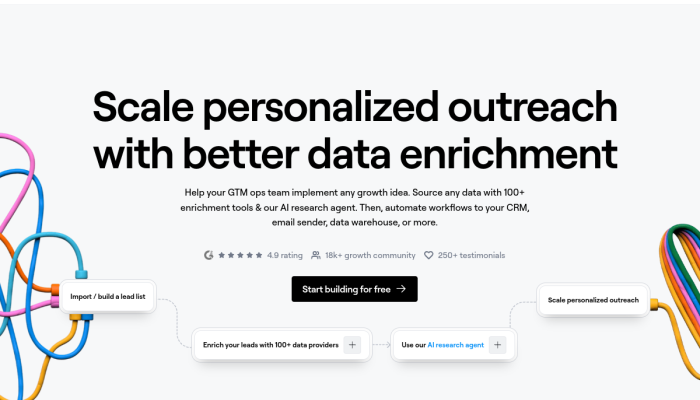
Top Clay Alternatives & Competitors based on 321 Reviews
Reviews collected from
trustpilot.com
facebook.com
producthunt.com
capterra.com
trustradius.com
reviews.io
gartner.com
softwareadvice.com
sitejabber.com
.
| Brand | Pricing |
|---|---|
|
☆ ☆ ☆ |
|
|
☆ ☆ |
Offers a free plan and paid per-user tiers. Publicly advertised pricing has typically started around $49 per user/month, with higher tiers around $79 and $119 per user/month when billed annually. Plans differ in credits, integrations, and sales engagement features. |
|
☆ |
Does not appear to offer a straightforward public price for its standalone product. Clearbit is part of HubSpot, and its data-enrichment features are generally offered through HubSpot’s Breeze Intelligence credit-based options or via a sales quote. |
|
☆ |
|
|
☆ ☆ |
Offers seat-based plans, including a self-serve Pro option and a custom-priced Business plan. Public pricing has typically started around $39 per seat/month on annual billing; Business pricing is quote-based. |
|
☆ ☆ |
Has a free plan plus paid Pro and Premium plans, with a custom Scale option. Publicly advertised annual-billing prices have typically started around $29 per user/month for Pro and $51 for Premium; credit allowances vary by plan. |
|
☆ ☆ |
Offers Essentials, Pro, and Ultimate plans, with pricing based on lookup limits and features. Public annual-billing prices have typically started around $33/month, rising to about $68 and $108/month for higher tiers. |
|
☆ ☆ |
|
|
☆ |
Offers Essentials and Plus plans, with a custom-priced Professional plan. Public pricing has typically started at about $99/month for Essentials and $199/month for Plus, with credit allowances increasing by tier. |
|
☆ ☆ ☆ |
Uses quote-based pricing rather than publishing standard plan prices. Packages and costs are tailored to product, seats, data needs, and contract terms; contact sales for a quote. |
Why should you be looking for a Clay alternative?
Users may seek Clay alternatives for more specialized features, simpler workflows, lower costs, or stronger support. This guide compares Apollo.io, Clearbit, Cognism, Jasper, Lusha, RocketReach, SalesIntel, UpLead, and ZoomInfo, examining their key features, pricing, and ideal users to help you find the right fit.
Quick Overview of Top Clay Competitors
- Apollo.io — Best all-in-one Clay Alternative for sales prospecting: Combines a B2B contact database with email sequencing, calling, and CRM integrations, making it a more bundled prospecting option than Clay’s data-enrichment and workflow approach.
- Clearbit — Best Clay Alternative for HubSpot data enrichment: Now part of HubSpot’s Breeze Intelligence, Clearbit is known for enriching company and contact records and supporting lead qualification within HubSpot workflows.
- Cognism — Best Clay Alternative for compliant international prospecting: Offers global B2B contact data, including its Diamond Data phone-verified mobile numbers, with a focus on compliant prospecting.
- Jasper — Adjacent Clay Competitor for AI-generated marketing content: Jasper is an AI content platform, not a B2B database. Its strengths include marketing content workflows and brand-voice features, so it is not a like-for-like substitute for Clay’s prospecting data and enrichment.
- Lusha — Best Clay Alternative for quick contact discovery: Provides contact and company data through its prospecting platform and browser extension, plus tools for data enrichment and sales prospecting.
- RocketReach — Best Clay Alternative for contact lookups: Helps users find professional email addresses and phone numbers, with search and API options for prospecting and data workflows.
- SalesIntel — Best Clay Alternative for human-verified data: Differentiates itself with human-verified B2B contact and company data, aimed at teams prioritizing data accuracy for sales outreach.
- UpLead — Best Clay Alternative for verified email prospecting: Offers B2B contact and company search, with email verification intended to help users validate addresses before outreach.
- ZoomInfo — Best Clay Alternative for enterprise sales intelligence: Provides a broad B2B data and sales-intelligence platform, including company and contact information, buying-intent data, and sales workflow tools.
Clay Alternatives: Feature by Feature Comparison
| Platform | Key features | How it compares with Clay | Distinctive or superior user benefits |
|---|---|---|---|
| Apollo.io | B2B contact and company database; email and phone data; prospect search and filtering; email sequences, dialer, and meeting tools; enrichment, buying signals, and sales analytics. | Like Clay, Apollo helps users find and enrich prospects. Apollo is more of an all-in-one prospecting and sales-engagement product, while Clay is built around flexible research, data enrichment, and automated workflows that can combine multiple providers. | Fewer tools to operate outbound. Users can identify prospects and contact them through Apollo’s built-in engagement tools, rather than building a Clay workflow and sending records to a separate sequencer. Its packaged interface can also be easier for teams that want a standard prospecting process rather than highly customizable workflows. |
| Clearbit | Company and contact data enrichment; company identification from website traffic and IP addresses; form enrichment and shortening; APIs and integrations. Clearbit is part of HubSpot, and its capabilities have been incorporated into HubSpot offerings; product names and availability may vary. | Clay can enrich records using multiple data sources and chain steps together. Clearbit’s strongest fit is enriching and identifying records within a HubSpot-centered marketing and sales stack, rather than orchestrating a broad, custom workflow across many vendors. | HubSpot-native enrichment and visitor identification. For HubSpot users, enriching records and recognizing visiting companies can fit directly into existing marketing and CRM processes. Company-level identification is useful when a site visitor is not yet known as an individual contact. |
| Cognism | B2B contact and company data; phone-verified mobile numbers through its Diamond Data offering; prospecting and filtering; intent data; CRM and sales-tool integrations; features designed for international prospecting and compliance. | Clay offers flexible enrichment across data providers, which can help teams compare or combine sources. Cognism is a more focused sales-intelligence source, particularly for teams that prioritize phone data and prospecting in Europe and other international markets. | Phone-first prospecting and European coverage. Its phone-verification emphasis can help sales teams that rely on calling, while its compliance positioning can be valuable for organizations prospecting across jurisdictions. |
| Jasper | AI-assisted marketing content creation; campaign and content workflows; brand voice and style controls; reusable knowledge and context; collaboration and governance features. | Jasper is not a direct Clay alternative: it focuses on generating and managing marketing content, while Clay focuses on prospect data, enrichment, and sales or marketing workflows. The products can complement one another—for example, Clay can assemble prospect context and Jasper can help turn approved messaging into campaign content. | Marketing-content production at scale. Brand voice, shared context, and campaign-oriented workflows help marketing teams create consistent assets across formats. This is a stronger fit than Clay for teams whose primary need is drafting and governing marketing content. |
| Lusha | Contact and company search; email and phone details; browser extension for finding contacts while browsing; list building; enrichment; integrations, API access, and buying-signal features depending on plan. | Both tools support prospect research and enrichment. Clay is more oriented toward building custom, multi-step workflows and using several data sources; Lusha is more direct for looking up a person or company and getting contact details quickly. | Fast, lightweight contact discovery. The browser extension makes it convenient to capture prospect details while working on company websites or professional profiles. That can suit individual reps and smaller teams that want quick lookups without designing a broader data workflow. |
| RocketReach | Search for people and companies; email and phone lookup; bulk lookups; browser extension; API access and integrations for embedding lookups into other systems. | Clay can combine providers and apply logic across an enrichment process. RocketReach is more focused on straightforward contact discovery and lookup, so it can be simpler when the task is to find contact details for a known person or target list. | Convenient individual and bulk lookup. Users can move from a name, company, or domain to contact details, with an extension for on-the-fly research and bulk options for larger lists. Its focused lookup experience can be easier for teams that do not need Clay’s broader workflow customization. |
| SalesIntel | B2B contact and company data; human-verified research; Research-on-Demand; intent and technographic data; organizational information and sales triggers; CRM integrations. | Clay can draw on multiple data providers and automate enrichment steps. SalesIntel’s emphasis is on its own sales-intelligence data and research services, which can provide a more guided route to validating or finding target-account information. | Human-supported research. Research-on-Demand is a differentiator for requests that need additional investigation rather than only automated database matching. Human verification can be particularly useful for account lists where contact accuracy matters to a calling or account-based sales motion. |
| UpLead | B2B contact and company search; real-time email verification; prospecting filters; technographic and intent data; list building, enrichment, and API access. | Clay is more customizable for chaining enrichment sources, applying AI research, and automating downstream steps. UpLead is more focused on finding and verifying prospect records directly in a prospecting interface. | Email verification at the point of prospecting. Real-time verification can help reduce invalid addresses before users export or activate a list. Its search-and-filter workflow is a practical fit for teams that want to build lists without configuring a multi-source Clay workflow. |
| ZoomInfo | Large B2B contact and company database; intent data; organizational charts and company insights; website visitor identification; sales engagement and workflow tools; conversation intelligence and operations products, with availability varying by package. | Clay’s strength is flexibility: it can orchestrate enrichment from multiple sources and tailor workflows to a team’s process. ZoomInfo is a broader, packaged revenue-intelligence platform, combining data with intent, engagement, and other sales or marketing capabilities. | Breadth across revenue operations. ZoomInfo can provide prospect data alongside tools for identifying in-market accounts, engaging prospects, and analyzing sales conversations. That breadth may suit larger organizations seeking a consolidated platform, while Clay can be preferable when teams want to choose and combine tools more selectively. |
Comparison note: Clay’s main distinction across these comparisons is its workflow flexibility: teams can combine data sources, run enrichment and research steps, and route results into other tools. The alternatives may be stronger when users want a specific capability built into a more packaged product—such as Apollo’s sales engagement, Cognism’s phone data, Jasper’s content workflows, or ZoomInfo’s broader revenue platform.
Integration Capabilities for each Clay competitor
| Alternative | Supported Integrations | Compatibility Notes |
|---|---|---|
| Apollo.io | Salesforce, HubSpot, Pipedrive, Outreach, Salesloft, Marketo, Gmail, Outlook, Zapier | Strong overlap with Clay for CRM and sales-engagement workflows. Apollo also combines prospect data with sequencing; check plan and sync limits for CRM connections. |
| Clearbit | Salesforce, HubSpot, Marketo, Pardot, Segment, Slack, Intercom, Drift | Overlaps with Clay on CRM enrichment and marketing-data workflows. Clearbit’s HubSpot relationship and product availability may affect which integrations are currently offered. |
| Cognism | Salesforce, HubSpot, Microsoft Dynamics 365, Pipedrive, Outreach, Salesloft; API | Covers several of the same CRMs and sales-engagement tools as Clay. Its integration set is oriented toward sales-data delivery; confirm whether a connection is native or API-based. |
| Jasper | Google Docs, Google Sheets, Chrome, Surfer SEO, Grammarly, Copyscape, WordPress, Shopify, Webflow | Not a B2B contact-data platform, so its integrations are not a like-for-like alternative to Clay’s CRM, sales-engagement, and data-workflow connections. |
| Lusha | Salesforce, HubSpot, Pipedrive, Microsoft Dynamics 365, Zoho CRM, Bullhorn, Outreach, Salesloft, Zapier | Good CRM overlap with Clay, plus connections to sales-engagement tools. Some destinations or workflows may rely on Zapier rather than a direct sync. |
| RocketReach | Salesforce, HubSpot, Pipedrive, Gmail, Outlook, Zapier; API and browser extensions | Shares common CRM destinations with Clay. Its integrations emphasize finding and transferring contact details; Clay offers broader workflow-building and enrichment options. |
| SalesIntel | Salesforce, HubSpot, Microsoft Dynamics 365, Outreach, Salesloft, Marketo, Pardot; API | Overlaps with Clay across major CRM and sales-engagement tools. Marketing-automation connections can suit lead-routing workflows; verify availability by plan. |
| UpLead | Salesforce, HubSpot, Pipedrive, Zoho CRM, Microsoft Dynamics 365, Freshsales, Insightly, Copper, Zapier | Covers many of the same CRM destinations as Clay. The range of CRM options is useful for smaller teams, while Clay is more focused on combining data sources and automating multi-step workflows. |
| ZoomInfo | Salesforce, HubSpot, Microsoft Dynamics 365, Oracle, SugarCRM, Marketo, Eloqua, Pardot, Outreach, Salesloft, Snowflake | Broad overlap with Clay across CRM, sales-engagement, and marketing-automation systems. ZoomInfo also supports enterprise data workflows; integration availability and depth can depend on product and plan. |
Major examples from the vendors’ integration pages; not exhaustive. Integration methods and availability can vary by product, plan, and account configuration.
Pros and Cons of each Clay Alternative
Clay is primarily a GTM data-enrichment and workflow platform: it combines data sources and lets teams build custom prospecting workflows. The alternatives below are generally more focused on a particular database, sales workflow, or use case.
| Alternative | Pros compared with Clay | Cons compared with Clay |
|---|---|---|
| Apollo.io | Combines a prospect database with email sequencing and sales engagement, so teams can find contacts and run outreach in one product. Often easier to start with than building a custom Clay workflow. | Less flexible for combining many data providers and building bespoke enrichment workflows. Data coverage and accuracy can vary by contact and region. |
| Clearbit (now part of HubSpot’s Breeze Intelligence) | Strong fit for HubSpot users who want company and contact enrichment, form shortening, and related data inside their existing CRM and marketing workflows. | More tied to the HubSpot ecosystem and less suited to stitching together multiple third-party sources or building highly customized prospecting workflows than Clay. |
| Cognism | Particularly useful for teams selling internationally, including in EMEA, that need compliant business-contact data and mobile numbers. Offers a focused sales-intelligence experience rather than requiring teams to assemble one. | Less adaptable for custom, multi-source enrichment and automated research workflows. May be a less economical fit for teams that don’t need its regional data strengths or enterprise sales features. |
| Jasper | Built for marketing content creation, with tools for drafting and adapting copy. It is a more direct fit than Clay when the primary task is producing marketing content rather than building prospect lists. | Not a comparable source of prospect and company data: it does not replace Clay’s enrichment, data-provider integrations, or GTM workflow automation. |
| Lusha | Offers a relatively direct way to find business contact details through its search tools and browser extension. Can suit reps who want contact lookup without designing a broader workflow. | Less capable than Clay for combining data sources, applying custom enrichment logic, and automating multi-step research. Coverage may not fit every market or niche. |
| RocketReach | Focuses on finding professional email addresses and phone numbers, with search and API options for teams that need contact lookup or data access. | More limited as a platform for orchestrating enrichment across providers and building custom GTM processes. Teams may need separate tools for other prospecting and outreach steps. |
| SalesIntel | Offers human-verified contact data and sales-intelligence features, which can help teams that prioritize verified contacts and research support. | Less flexible than Clay for assembling custom workflows from a wide range of data sources. Its verification and sales-intelligence focus may be unnecessary for teams seeking general-purpose enrichment automation. |
| UpLead | Emphasizes verified business contact data and straightforward list-building, making it useful when the main need is finding and validating prospect details. | Offers less workflow flexibility than Clay for multi-source enrichment, custom research, and automated data pipelines. It may also be less suited to teams that need a broad GTM orchestration layer. |
| ZoomInfo | Provides a broad B2B database and a more comprehensive enterprise sales-intelligence suite, including capabilities such as intent data and organizational insights. Can support teams looking for a consolidated vendor. | Typically a more enterprise-oriented purchase, with potentially greater cost and implementation complexity. Clay is more flexible for teams that want to choose and combine data sources or tailor workflows themselves. |
In short: choose Clay when custom enrichment and workflow flexibility are central. The alternatives may be a better fit when the priority is a ready-made contact database, a particular region or verification approach, HubSpot integration, sales engagement, or content creation. Product features, data coverage, and pricing can vary by plan and region.
Clay vs Competitors: Traffic & Marketing Comparison
Traffic comparison: Clay is the only brand with organic-traffic data, so a reliable highest-to-lowest comparison across all ten brands isn’t possible. Clay’s recorded traffic peaked at about 1.89 million in September 2025 and was about 1.43 million in November 2025, up from about 544,000 in November 2024. Traffic for the other brands is unreported—not necessarily zero.
Top-performing keywords: Clay, Apollo.io, Jasper, and ZoomInfo have the broadest reported sets of #1-ranking keywords. Clay ranks first for terms including “marketing automation,” “customer database,” and “workflow tools”; Apollo and Jasper emphasize AI and marketing terms, while ZoomInfo also covers business intelligence and data management. Other brands have narrower lists: Cognism’s “customer data” ranks sixth. Rankings alone don’t show which keywords drive the most traffic.
Visibility and reach: The keyword data points to broad search visibility for Apollo.io, Jasper, ZoomInfo, and Clay, with strong coverage across AI, marketing, and business terms. Clay is the only brand whose traffic is measurable here, and it shows substantial reach, but the missing traffic figures prevent an overall traffic winner from being named. Niche signals include SalesIntel’s B2B data terms, Lusha’s contact-management terms, and Cognism’s customer-data ranking.
Other “Clay” Alternatives & Competitors that you can find for free
| Competitor | Key features | Trend | Value proposition |
|---|---|---|---|
| Persana AI | AI-assisted prospecting, contact and company enrichment, buying signals, and automated GTM workflows | Moves prospecting toward AI-driven, signal-based research | Helps teams find and qualify leads and automate outreach preparation in one platform |
| Unify | Buyer-signal monitoring, account prioritization, audience building, and outbound campaign workflows | Combines intent signals with coordinated revenue workflows | Helps teams act on timely buying signals and reach accounts with more relevant outreach |
| Common Room | Collects signals from product usage, communities, social platforms, and other sources; supports contact identification and workflows | Expands prospecting beyond static databases to real-time customer and community activity | Helps teams spot potential buyers based on what they do, not just who they are |
| BetterContact | Waterfall contact enrichment that checks multiple data providers for verified business contact details | Uses multi-source enrichment to improve coverage and data accuracy | Offers a straightforward way to find and verify contact information without relying on a single database |
| Captain Data | No-code automation for extracting, enriching, and moving prospect data between tools | Automates repetitive list-building and data operations | Saves teams manual research time and connects prospecting workflows across their existing tools |
Broader trend: Clay alternatives are increasingly combining multiple data sources, buying-intent signals, and AI or no-code automation to make prospecting more timely and less manual.

